Sabtu, 29 September 2012


History of Taekwondo
|
THE HISTORY OF TAEKWONDO
Before I get into the history of Taekwondo, I would like to define
what it means. I read the definition from many books and the one that I like best comes
from the book Comprehensive Asian Fighting Arts (1)
written by Donn F. Draeger and Robert W. Smith. "Taekwondo is an empty-hand combat
form that entails the use of the whole body. Tae means "to Kick" or
"Smash with the feet," Kwon implies "punching" or
"destroying with the hand or fist," and Do means "way" or
"method." Taekwondo thus, is the technique of unarmed combat for self defense
that involves the skillful application of techniques that include punching, jumping kicks,
blocks, dodges, parrying actions with hands and feet. It is more than a mere physical
fighting skill, representing as it does a way of thinking and a pattern of life requiring
strict discipline. It is a system of training both the mind and the body in which great
emphasis is placed on the development of the trainee's moral character."Taekwondo is a martial art that in "todays" form of self defense has evolved by combining many different styles of martial arts that existed in Korea over the last 2,000 years and some martial arts styles from countries that surround Korea. Taekwondo incorporates the abrupt linear movements of Karate and the flowing, circular patterns of Kung-fu with native kicking techniques. Over fifty typically Chinese circular hand movements can be identified in modern Taekwondo.(1) A few of the earlier martial arts styles that contributed to Taekwondo are: T'ang-su, Taek Kyon, also known as Subak, Tae Kwon, Kwonpup and Tae Kwonpup. There are also influences from Judo, Karate, and Kung-fu. "The earliest records of Taekwondo practice date back to about 50 B.C. During this time, Korea was divided into three kingdoms: Silla, which was founded on the Kyongju plain in 57 B.C.; Koguryo, founded in the Yalu River Valley in 37 B.C.; and Paekche, founded in the southwestern area of the Korean peninsula in 18 B.C.."(2) Tae Kyon ( also called Subak) is considered the earliest known form of Taekwondo. Paintings from this time period have been found on the ceiling of the Muyong-chong, a royal tomb from the Koguryo dynasty. The paintings show unarmed people using techniques that are very similar to the ones used by Taekwondo today. Although Taekwondo first appeared in the Koguryo kingdom, it is the Silla's Hwarang warriors that are credited with the growth and spread of Taekwondo throughout Korea. Silla was the smallest of the three kingdoms and was always under attack by Japanese Pirates. Silla got help from King Gwanggaeto and his soldiers from the Koguryo kingdom to drive out the pirates. During this time a few select Sillan warriors were given training in Taek Kyon by the early masters from Koguryo. The Taek Kyon trained warriors then became known as the Hwarang. The Hwarang set up a military academy for the sons of royalty in Silla called Hwarang-do, which means "The way of flowering manhood." The Hwarang studied Taek Kyon, history, Confucian Philosophy, ethics, Buddhist Morality, and military tactics. The guiding principles of the Hwarang warriors were loyalty, filial duty, trustworthiness, valor, and justice.(3) The makeup of the Hwarang-do education was based on the Five Codes of Human Conduct written by a Buddhist scholar, fundamental education, Taek Kyon and social skills. Taek Kyon was spread throughout Korea because the Hwarang traveled all around the peninsula to learn about the other regions and people. Today, The original Five Codes of Human Conduct have been correlated into the so-called Eleven Commandments of modern day Taekwondo, which are:
During the Silla dynasty (A.D. 668 to A.D. 935) Taek Kyon was mostly used as a sport and recreational activity. Taek Kyon's name was changed to Subak and the focus of the art was changed during the Koryo dynasty (A.D. 935 to A.D. 1392). When King Uijong was on the throne from 1147 through 1170, he changed Subak from a system that promotes fitness to primarily a fighting art. The first widely distributed book on Taekwondo was during the Yi dynasty (1397 to 1907). This was the first time that Subak was intended to be taught to the general public, in previous years the knowledge was limited to the military. During the second half of the Yi dynasty, political conflicts and the choice to use debate instead of military action almost lead to the extinction of Subak. The emphasis of the art was changed back to that of recreational and physical fitness. The lack of interest caused Subak as an art, to become fragmented and scarcely practiced throughout the country. In 1909 the Japanese invaded Korea and occupied the country for 36 years. To control Korea's patriotism, the Japanese banned the practice of all military arts, Korean language and even burned all books written in Korea. This ban was responsible for renewed interest in Subak. Many Koreans organized themselves into underground groups and practiced the martial arts in remote Buddhist temples. Other people left Korea to study the martial arts in other countries like China and Japan. In 1943 Judo, Karate and Kung-fu were officially introduced to the Korean residents and the martial arts regained popularity. In 1945 Korea was liberated. In the last few years before liberation, there were many different variations of Subak/Taek Kyon in Korea. This was due to all of the other martial arts influence on it. The first Taekwondo school (Kwan) was started in Yong Chun, Seoul, Korea in 1945. Many different school were opened from 1945 through 1960. Each school claimed to teach the traditional Korean martial art, but each school emphasized a different aspect of Taek Kyon/Subak. This caused different names to emerge from each system, some of them were: Soo Bahk Do, Kwon Bop, Kong Soo Do, Tae Soo Do and Kang Soo Do. The Korean Armed Forces were also formed in 1945 and in 1946 Second lieutenant Hong Hi Choi began teaching Taek Kyon at a Korean military base called Kwang Ju. Americans were first introduced to Taek Kyon when Choi instructed Korean Army troops and some American soldiers stationed with the 2nd Infantry Regiment. Later in 1949 Hong Hi Choi attended Ground General School at Ft. Riely near Topeka, Kansas in the United States. While in the U.S., Choi gave public Taek Kyon demonstrations for the troops. This was the first display of Taek Kyon in America.(4) The greatest turning point for Korean martial arts started in 1952. During the height of the Korean War, President Syngman Rhee watched a 30 minute performance by Korean martial arts masters. He was especially impressed when Tae Hi Nam broke 13 roof tiles with a single punch. After the demonstration Rhee talked with Hong Hi Choi about the martial arts, he then ordered his military chiefs of staff to require all Korean soldiers to receive training in the martial arts. This caused a tremendous surge in Taek Kyon schools and students. President Rhee also sent Tae Hi Nam to Ft. Benning, Georgia for radio communications training. While there, Tae Hi Nam gave many martial arts demonstrations and received considerable media publicity. During this same time period in Korea, special commando groups of martial arts-trained soldiers were formed to fight against the communist forces of North Korea. One of the most famous special forces was known as the Black Tigers. The Korean war ended in 1953. In 1954, General Hong Hi Choi organized the 29th Infantry on Che Ju Island, off the Korean Coast, as a spearhead and center for Taek Kyon training in the military. On April 11, 1955 at a conference of kwan masters, historians, and Taek Kyon promoters, most of the kwan masters decided to merge their various styles for mutual benefit of all schools. The name "Tae Soo Do" was accepted by a majority of the kwan masters. Two years later the name was changed again, this time to "Taekwondo" The name was suggested by General Hong Hi Choi (who is considered the father of Taekwondo). "Taekwondo" was suggested by Choi because of its resemblance to Taek Kyon, and so provides continuity and maintains tradition. Further, it describes both hand and foot techniques. Dissension among the various kwans that did not unify carried on until September 14, 1961. Then by official decree of the new military government, the kwans were ordered to unify into one organization called the Korea Taekwondo Association (KTA), with General Hong Hi Choi elected as its first president. In 1962, the KTA re-examined all the black belt ranks to determine national standards and also in 1962, Taekwondo became one of the official events in the annual National Athletic Meet in Korea. The KTA sent instructors and demonstrations teams all over the world. Jhoon Rhee (who is considered the father of American Taekwondo) attended San Marcos Southwest Texas State College, and later taught a Taekwondo course at the college and formed a public Taekwondo club. A Taekwondo demonstration at the United Nations headquarters in New York City in 1963, caused the formation of the U.S. Taekwondo Association in 1967, which later was superseded in 1974 by the U.S. Taekwondo Federation. In Korea, the study of Taekwondo spread rapidly from the army into high schools and colleges. In march of 1966 Choi founded the International Taekwon-do Federation (ITF), which he also served as president. Choi later resigned as the KTA president and moved his ITF headquarters to Montreal, Canada, from where he concentrated on organizing Taekwondo internationally. His emphasis is on self-defense methodology, not particularly on the sport. By 1974, Choi reported that some 600 qualified ITF instructors were distributed throughout the world. Young-wun Kim was elected the new KTA president. Feeling that Korea was the mother country of Taekwondo and that the world headquarters should be located there, he dissolved the ITF's connection with the KTA and on May 28, 1973 created a new international governing body called the World Taekwondo Federation (WTF), which coincided with the first World Taekwondo Championships that were held in Seoul, Korea. At the first inaugural meeting, Un Yong Kim was elected as president of the WTF and drafted a charter for the federation. The WTF is the only official organization recognized by the Korean government as an international regulating body for Taekwondo. The World Taekwondo Federation has since made a major effort to standardize tournament rules and organize world class competitions. After the 2nd World TKD Championship in Seoul, the WTF became an affiliate of the General Assembly of International Sports Federation (GAISF), which has ties to the International Olympic Committee (IOC). The IOC recognized and admitted the WTF in July 1980. In 1982 the General Session of the IOC designated Taekwondo as an official Demonstration Sport for the 1988 Olympic Games in Seoul, Korea. Since Modern-day Taekwondo's official birth on April 11, 1955, its development as a sport has been rapid. Over 30 million people practice Taekwondo in more than 156 countries. |
Music
Basic Lesson : Major Scale
Hi all,Here I want to share one that plg basic learning within the music; Major Scale.
must have been many who know and understand what Major Scale. But for those who do not understand, summarize it in the language that the Major Scale 'in Indonesia' means Nada Major Appliances. Major scale which here means 'main'. like the foundation of the building, Major Scale is the foundation of the music, it's very important to learn as he later would become a benchmark for determining the formula or the formula for another Scale2, triads, arpeggios, and other material other in music is rooted in the
Major Scale.
Ok here it is Major Scale, do-re-mi-fa-sol-la-si-do '(nah right udh someone know hehe ..) where there are 7 tones that are very familiar in our ears. With notation numbers mean 1-2-3-4-5-6-7-1 '. we start with the C Major Scale. C Major Scale mean C-D-E-F-G-A-B-C. we saw in the distance piano tones per tone, there is a distance of tone 1 (whole) sample; distance tones C to D, G to A. and some half-tone distance (half) as E to F and B to C. so later in the order of distance formula can tune; 1-1-1/2-1-1-1-1/2 or wwhwwwh.
Now consider the formula is the mean distance wwhwwwh 1 (do) to 2 (re) is a tone (w). Distance 2 (re) to 3 (mi), the tone (w) as well. Distance 3 (mi) to 4 (fa) is a half-tone (h). and so on, so that we can look within the image below
*note to 8 it is' do 'as well, but one octave higher, usually replaced by 1'
By understanding the tone of the distance formula, we can play a Major Scale on the basic tone (do) the other, for example, we will play the G Major Scale. if we do not know, maybe we'll spell the G Major Scale like this; GABCDEF-G '. so straight aja appropriate degree (order) it. And that is in fact not the G Major Scale. Because the distance is not appropriate formula. let us consider satu2 distance;
w w w w h h w
1 2 3 4 5 6 7 1 '
G - A - B - C - D - E - F - G '
above we see the distance E to F is a half tone (h), while the Major Scale formula requires 6 to 7 range tones are 1 tone (w). well here we have to adjust again the distance, the way to raise the tone of his half-tone F. It can be done with one function signs Accidental (Accidental Sign). Sign Accidental there are three kinds, namely;
1. Sharp sign (#) or sharps in the Indonesian language. function is to raise half a tone.
2. The flat sign (b) or moles in the Indonesian language. function to lower half tone.
3. Natural signs. function to restore to its original tone.
example: C note our half-tone into tone Rev C # (C sharp), G up half-finished G #, etc.
Another example B we derive a half, so the tone Bb (B flat), E dropped half-tone Eb, etc. Natural signs we discussed on another occasion. this way we are also familiar with the term Enharmonis, two of his monotone sound, but different names.
Example: F # = Gb C # = Db (* see picture above the piano keys again)
So with this accidental mark, we not only have 7 tones only in music, but 12 tone / key called Chromatic (Chromatic Scale). as well as Major Scale, Chromatic scale is also, which have half the distance formula in every note.
Now back to G Major Scale td. By raising F to F #, then we can distance the right tone
w w w w w h h
1 2 3 4 5 6 7 1 '
G - A - B - C - D - E - F # - G '
so if the G Major Scale, tone to the 7 (si) it is not F lg, but that really is the tone of F #. thus its impact later when the material further, we are not going wrong. That is like this, take for instance the example in the matter of Arpeggio (* a detailed discussion about the arpeggio on another occasion) brief explanation Major 7 Arpeggio formula is 1-3-5-7 (meaning we only played to the tune Do, Mi, Sol, Si) , if we play the tones C is easy to cite the contents of his tone is; CEGB, well if we change its basic tone to G, if basic Major Scale, we 'do not understand', maybe we'll play it like this GBDF. obviously it's wrong, because it should tone to 7 (si) of the G major scale is F #. so G major 7th arpeggio correct the G-B-D-F #. This discussion does not matter basic arpeggio, but here I am trying to illustrate the importance of understanding the Major Scale, just as I said at the beginning :)
Now we take the example of Major Scale on the other tones, such as F Major Scale. appropriate if we misspelled his degree like this happens;
w w w w w h h
1 2 3 4 5 6 7 1 '
F - G - A - B - C - D - E - F '
obviously this is not the F Major Scale, now we adjust by lowering the tone B to Bb,
w w w w w h h
1 2 3 4 5 6 7 1 '
F - G - A - Bb - C - D - E - F '
so in F Major Scale, tone to 4 (fa) it is a Bb.
Up here it seems we see there are 2 kinds of its key benchmark; Key of Sharp & Key of Flat. G Major Scale is also called the Major Scale 1 #, because the contents are one sign of Sharp's tone is the tone F #. while the F Major Scale is also called the Major Scale 1b, as in F Major Scale there is one sign the flat, the tone of Bb. Major Scale and are contained until 7 sharp (#), and 7 flats (b) as well.
The following diagram details; wwhwwwh 1 # G Major: G - A - B - C - D - E - F # - G '2 # D Major: D - E - F # - G - A - B - C # - D' 3 # A Major: A - B - C # - D - E - F # - G # - A '4 # E Major: E - F # - G # - A - B - C # - D # - E' 5 # B Major: B - C # - D # - E - F # - G # - A # - B '6 # F # Major: F # - G # - A # - B - C # - D # - E # - F #' 7 # C # Major: C # - D # - E # - F # - G # - A # - B # - C # '* 6 #> F # enharmonis with Gb, 7 #> C # enharmonis with Db wwhwwwh 1b F Major: F - G - A - Bb - C - D - E - F' 2b Bb Major: Bb - C - D - Eb - F - G - A - Bb '3b Eb Major: Eb - F - G - Ab - Bb - C - D - Eb' Ab Major 4b: Ab - Bb - C - Db - Eb - F - G - Ab '5b Db Major: Db - Eb - F - Gb - Ab - Bb - C - Db '6b Gb Major: Gb - Ab - Bb - Cb - Db - Eb - F - Gb' Major 7b Cb: Cb - Db - Eb - Fb - Gb - Ab - Bb - Cb 'nah he briefed Major Scale, it helps us memorize the entire contents of a 12-key tone is Major Scale, it seems an awful lot that needs to be memorized. so it should be memorized little, one by one key, while practicing his fingering on the instrument that we are good at. If you need to while we sing tone, it will be more fun for us to practice. so it is not like chasing rote system with racing last night: D
Hi all,Here I want to share one that plg basic learning within the music; Major Scale.
must have been many who know and understand what Major Scale. But for those who do not understand, summarize it in the language that the Major Scale 'in Indonesia' means Nada Major Appliances. Major scale which here means 'main'. like the foundation of the building, Major Scale is the foundation of the music, it's very important to learn as he later would become a benchmark for determining the formula or the formula for another Scale2, triads, arpeggios, and other material other in music is rooted in the
Major Scale.
Ok here it is Major Scale, do-re-mi-fa-sol-la-si-do '(nah right udh someone know hehe ..) where there are 7 tones that are very familiar in our ears. With notation numbers mean 1-2-3-4-5-6-7-1 '. we start with the C Major Scale. C Major Scale mean C-D-E-F-G-A-B-C. we saw in the distance piano tones per tone, there is a distance of tone 1 (whole) sample; distance tones C to D, G to A. and some half-tone distance (half) as E to F and B to C. so later in the order of distance formula can tune; 1-1-1/2-1-1-1-1/2 or wwhwwwh.
Now consider the formula is the mean distance wwhwwwh 1 (do) to 2 (re) is a tone (w). Distance 2 (re) to 3 (mi), the tone (w) as well. Distance 3 (mi) to 4 (fa) is a half-tone (h). and so on, so that we can look within the image below
*note to 8 it is' do 'as well, but one octave higher, usually replaced by 1'
By understanding the tone of the distance formula, we can play a Major Scale on the basic tone (do) the other, for example, we will play the G Major Scale. if we do not know, maybe we'll spell the G Major Scale like this; GABCDEF-G '. so straight aja appropriate degree (order) it. And that is in fact not the G Major Scale. Because the distance is not appropriate formula. let us consider satu2 distance;
w w w w h h w
1 2 3 4 5 6 7 1 '
G - A - B - C - D - E - F - G '
above we see the distance E to F is a half tone (h), while the Major Scale formula requires 6 to 7 range tones are 1 tone (w). well here we have to adjust again the distance, the way to raise the tone of his half-tone F. It can be done with one function signs Accidental (Accidental Sign). Sign Accidental there are three kinds, namely;
1. Sharp sign (#) or sharps in the Indonesian language. function is to raise half a tone.
2. The flat sign (b) or moles in the Indonesian language. function to lower half tone.
3. Natural signs. function to restore to its original tone.
example: C note our half-tone into tone Rev C # (C sharp), G up half-finished G #, etc.
Another example B we derive a half, so the tone Bb (B flat), E dropped half-tone Eb, etc. Natural signs we discussed on another occasion. this way we are also familiar with the term Enharmonis, two of his monotone sound, but different names.
Example: F # = Gb C # = Db (* see picture above the piano keys again)
So with this accidental mark, we not only have 7 tones only in music, but 12 tone / key called Chromatic (Chromatic Scale). as well as Major Scale, Chromatic scale is also, which have half the distance formula in every note.
Now back to G Major Scale td. By raising F to F #, then we can distance the right tone
w w w w w h h
1 2 3 4 5 6 7 1 '
G - A - B - C - D - E - F # - G '
so if the G Major Scale, tone to the 7 (si) it is not F lg, but that really is the tone of F #. thus its impact later when the material further, we are not going wrong. That is like this, take for instance the example in the matter of Arpeggio (* a detailed discussion about the arpeggio on another occasion) brief explanation Major 7 Arpeggio formula is 1-3-5-7 (meaning we only played to the tune Do, Mi, Sol, Si) , if we play the tones C is easy to cite the contents of his tone is; CEGB, well if we change its basic tone to G, if basic Major Scale, we 'do not understand', maybe we'll play it like this GBDF. obviously it's wrong, because it should tone to 7 (si) of the G major scale is F #. so G major 7th arpeggio correct the G-B-D-F #. This discussion does not matter basic arpeggio, but here I am trying to illustrate the importance of understanding the Major Scale, just as I said at the beginning :)
Now we take the example of Major Scale on the other tones, such as F Major Scale. appropriate if we misspelled his degree like this happens;
w w w w w h h
1 2 3 4 5 6 7 1 '
F - G - A - B - C - D - E - F '
obviously this is not the F Major Scale, now we adjust by lowering the tone B to Bb,
w w w w w h h
1 2 3 4 5 6 7 1 '
F - G - A - Bb - C - D - E - F '
so in F Major Scale, tone to 4 (fa) it is a Bb.
Up here it seems we see there are 2 kinds of its key benchmark; Key of Sharp & Key of Flat. G Major Scale is also called the Major Scale 1 #, because the contents are one sign of Sharp's tone is the tone F #. while the F Major Scale is also called the Major Scale 1b, as in F Major Scale there is one sign the flat, the tone of Bb. Major Scale and are contained until 7 sharp (#), and 7 flats (b) as well.
The following diagram details; wwhwwwh 1 # G Major: G - A - B - C - D - E - F # - G '2 # D Major: D - E - F # - G - A - B - C # - D' 3 # A Major: A - B - C # - D - E - F # - G # - A '4 # E Major: E - F # - G # - A - B - C # - D # - E' 5 # B Major: B - C # - D # - E - F # - G # - A # - B '6 # F # Major: F # - G # - A # - B - C # - D # - E # - F #' 7 # C # Major: C # - D # - E # - F # - G # - A # - B # - C # '* 6 #> F # enharmonis with Gb, 7 #> C # enharmonis with Db wwhwwwh 1b F Major: F - G - A - Bb - C - D - E - F' 2b Bb Major: Bb - C - D - Eb - F - G - A - Bb '3b Eb Major: Eb - F - G - Ab - Bb - C - D - Eb' Ab Major 4b: Ab - Bb - C - Db - Eb - F - G - Ab '5b Db Major: Db - Eb - F - Gb - Ab - Bb - C - Db '6b Gb Major: Gb - Ab - Bb - Cb - Db - Eb - F - Gb' Major 7b Cb: Cb - Db - Eb - Fb - Gb - Ab - Bb - Cb 'nah he briefed Major Scale, it helps us memorize the entire contents of a 12-key tone is Major Scale, it seems an awful lot that needs to be memorized. so it should be memorized little, one by one key, while practicing his fingering on the instrument that we are good at. If you need to while we sing tone, it will be more fun for us to practice. so it is not like chasing rote system with racing last night: D
Jumat, 14 September 2012
Music
My name is Razak Harianto Artabangun. I love music, I can lay guitar and drums. I want to be guitarist and drummer known as Depapepe, Robert Bourdon, Phil Collins, Sunghajung and others. I like pop and rock music. I like Depapepe, Linkin Park, Muse, Green Day and others.
Barca Dinanti Laga Berat di Pekan pekan Sibuk
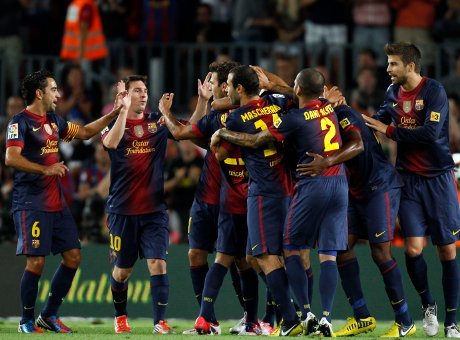
Pada Leg kedua Barcelona kalah 2-1 dari real madrid di Santiago Bernabue,agregatnya adalah 4-4 tapi Barcelona kalah karena barcelona kalah tandang dan akhirnya real madrid yang menjuarai laga pertama super spanish cup.Dan El Clasico La liga diadakan pada tanggal 7 Oktober 2012.
Langganan:
Postingan (Atom)